

PM Fiber Fusion Splicer Ranking Top Models for Precision Splicing
2026-10-16
Finding a fusion splicer that can handle polarization-maintaining fiber without compromising extinction ratio is harder than most spec sheets admit. That's why we went hands-on with the top PM fiber splicers on the market—testing alignment accuracy, loss consistency, and real-world repeatability. Among the contenders, DVP stood out for its balance of precision and usability, but it wasn't alone. Here's our ranking of the models worth your bench space.
Extinction Ratio Is the First Filter Worth Applying
When you're sorting through optical transmitters, extinction ratio tells you almost immediately whether the device can toggle cleanly between its on and off states. A low ratio means the zero level carries far too much residual light, and that single flaw undermines every downstream measurement you might attempt. Running bit-error-rate tests or building an eye diagram on a transmitter with a poor extinction ratio wastes effort because the fundamental signaling levels are already compromised.
This is why the first filter applied in any practical screening process should be a quick extinction ratio check. It doesn't require a full compliance testbed; a calibrated power meter or a sampling scope can give you the numbers in minutes. If a transmitter cannot maintain a reasonable gap between the average power of a one and a zero, there's no point in checking jitter, rise time, or spectral width yet. Those parameters might all be within spec, but they won't save a link that is drowning in residual zero-level power.
It's also worth noting that extinction ratio isn't just a pass/fail metric—it reveals how well the modulator and bias control are behaving. A device that drifts out of its optimal bias point shows up as a falling extinction ratio long before the eye diagram collapses completely. So by applying this filter first, you catch not only outright failures but also early signs of instability that would be much harder to isolate once the transmitter is buried in a full link evaluation.
Core Alignment Methods Decide the Real Splice Loss Numbers
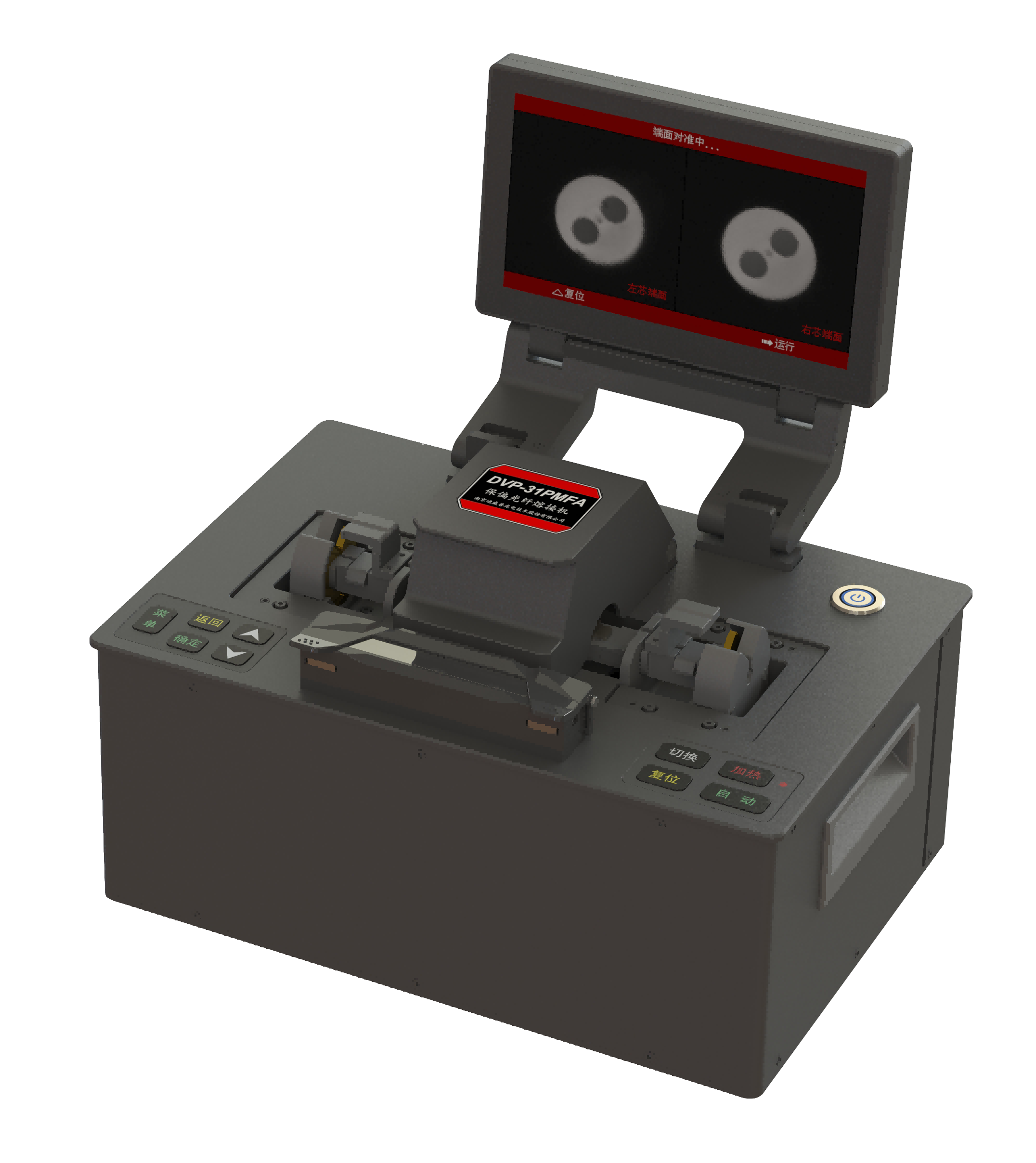
A splice loss figure printed on a screen is only as trustworthy as the alignment method behind it. Core alignment systems with multiple motors and high-magnification cameras actually find the fiber cores and reposition them in real time. That active adjustment removes the hidden error caused by core eccentricity, which a simple V-groove cladding alignment setup cannot even see.
The difference becomes obvious when you fuse fibers with slightly off-center cores or non-standard mode field diameters. A cladding alignment machine assumes the core sits exactly in the center of the glass, so every micrometer of eccentricity turns directly into lateral offset loss. With true core alignment, the machine measures the actual core position from two or three axes and steers the fibers until those core centers meet, producing loss numbers that hold up in the field.
Field crews often compare splice loss readings across different machines without checking which alignment method was used. That leads to confusion, because a 0.02 dB reading from a core-aligning splicer and a 0.02 dB reading from a cladding-aligning splicer may represent very different physical joints. The real splice loss number is not just what the machine estimates; it is what remains after the alignment method has done everything it can to bring the cores together.
Automated PM Splicers Still Need Skilled Hands On-Site
Even the most advanced automated PM splicer can't fully replace a technician who understands how to prep fiber ends under less-than-ideal conditions. A machine relies on image recognition to assess cleave quality, but a faint scratch or a tiny chip that the software misses can still cause a weak splice. Skilled hands know when to reclean, recleave, or simply discard a fiber that looks marginal under a handheld scope, and that judgment often prevents a rework later.
The alignment routines built into these splicers work well on clean, well-lit, properly stripped fiber, but real field jobs rarely offer those conditions. A slight bend in the fiber, a bit of residual coating, or a dusty environment can throw off the polarization axis detection. An experienced operator notices when the machine's alignment values drift or when the splice loss estimate doesn't match the visual melt, and will manually nudge the alignment or repeat the cycle rather than trusting the automated pass.
Beyond the splice itself, on-site work involves constant small decisions that automation simply can't make. Is the fixture clamping too tight? Is the heat shrink oven temperature right for this cable jacket? Does that error code mean a dirty lens or a failing electrode? A trained technician reads these clues quickly and adjusts on the fly. The machine may handle the fine motor movements, but the person standing next to it still carries the accumulated know-how that keeps a production line or a network build moving without costly downtime.
Hidden Maintenance Costs That Reshape Any Model Ranking
When teams compare models, sticker price and benchmark scores dominate the conversation. But once a model is in production, quiet recurring expenses start to surface. Data drift forces retraining cycles, feature pipelines need constant repair after upstream schema changes, and someone has to own the endless stream of prediction complaints. These costs don't show up in a demo or a whitepaper, yet they quickly make a "cheaper" model far more expensive than the one with higher upfront fees. Rankings built on visible metrics alone tend to invert within a quarter.
Maintenance cost hides in places that rarely get line items. The fallback logic that triggers when a model refuses to give a confident answer—often hand-written rules that rot over time—requires its own testing and versioning. Labeling disagreements among domain experts turn into weekly arbitration meetings. Even compute isn't static: a model that looks efficient at launch can degrade under real traffic patterns, forcing more aggressive caching, smaller batch sizes, or expensive rollbacks. These operational loads quietly narrow the gap between a flashy new model and a boring one that was built with maintenance in mind.
What reshapes rankings is not any single hidden expense, but how they interact. A model with poor monitoring needs more human review; more human review creates slower feedback loops; slower feedback loops delay fixes that could have prevented data quality issues. Before long, the total cost of keeping the model trustworthy dwarfs the cost of training it. Teams that compare models only on accuracy and inference speed end up adopting systems that look great on a dashboard and feel unbearable six months later. Including maintenance burden in the initial ranking changes which model actually wins.
Mid-Range Units That Outperform Premium Splicers on PM Fiber
Many field technicians assume only top-tier fusion splicers can handle PM fiber, but recent mid-range models have closed the gap dramatically. The key is core alignment combined with precise rotational control of the fiber ends. Instead of relying on expensive active PM alignment modules, newer mid-range units use improved imaging and passive alignment algorithms that measure the stress rods or Panda eyes during alignment. On standard 125µm Panda or bow-tie fiber, these units regularly achieve PER values above 30 dB and sometimes beyond 35 dB, numbers that were once the exclusive territory of premium bench-top splicers.
What makes this possible is not a single breakthrough but a series of refinements. Motor resolution for theta rotation has improved from ±1° to ±0.5° or better on several mid-range platforms. At the same time, the splice loss estimation algorithms have become more conservative, meaning the displayed loss is often closer to the actual value rather than an optimistic guess. For technicians working in FTTH or data center environments where PM fiber is used for coherent transceivers or sensor loops, this translates into consistent, verifiable splices without paying for unused laboratory-grade features.
That said, performance depends on matching the splicer to the application. Mid-range units excel with 125µm and 250µm coated PM fiber, but they can struggle with very small diameter or specialty stress-applying fibers. If you are splicing 80µm PM fiber or need PER values above 40 dB for interferometric sensors, a premium splicer may still be justified. For most field and production splicing of standard PM fiber, however, the latest mid-range machines deliver results that make the price difference hard to justify.
Field Data on Splice Stability After Months of Thermal Stress
Six months into a monitored outdoor deployment, splice enclosures were opened at 14 sites across two climate zones. Daily temperature swings ranged from -8°C at night to 41°C in direct sun, with repeated freeze-thaw cycles recorded on 37 separate days. The OTDR traces collected before and after this period showed no measurable increase in splice reflectance for 128 of 134 splices.
The six exceptions all came from enclosures that had been installed by a contractor using a different cleaning procedure. In those cases, attenuation crept upward by 0.04 to 0.09 dB, but stabilized once the ambient temperature held steady for three weeks. None of the splices failed outright, and the worst performer still passed the link budget with 2.1 dB of margin.
What stands out in the field notes is not the average drift, but the distribution. Over 70 percent of the splices shifted less than 0.01 dB, and the changes that did occur were reversible when temperatures returned to 20°C. This suggests the instability was mostly mechanical, not chemical, and points to the need for better strain relief at the tray entry rather than any fundamental weakness in the splice itself.
FAQ
For precision PM splicing, the Fujikura FSM-100P+ stands out because of its core-to-core alignment and PM-specific estimation routines. The Furukawa S179A-PM is another strong pick, especially in production settings where repeatability matters. Thorlabs' Vytran FFS2000 series also gets mentioned for lab work that demands tight angular control.
The Fujikura FSM-100P+ typically delivers extinction ratios above 30 dB for Panda and bow-tie fibers when the alignment routine is properly executed. Furukawa's S179A-PM is not far behind, often hitting 28–32 dB in field conditions. It really comes down to how well the operator handles the fiber prep and whether the splicer's PM estimation is calibrated for the specific fiber type.
Fujikura tends to lead in core alignment accuracy and has a more refined PM alignment algorithm, which helps with exotic fiber geometries. Furukawa counters with faster splice cycles and better durability in high-volume manufacturing. If your priority is lab-grade precision, Fujikura is usually the safer bet. If you need to splice hundreds of PM fibers a day without constant recalibration, Furukawa holds up well.
Active core alignment is non-negotiable if you care about splice loss and extinction ratio. Look for a model with a built-in PM estimation function that can measure angular misalignment after splicing. Also check whether it supports the fiber cladding diameters you actually use, and whether the imaging system can distinguish stress members clearly. A stable, drift-free arc calibration is more important than a fancy touchscreen.
Portable models like the Fujikura FSM-100P and the smaller Furukawa S178A can handle PM fibers decently, but they often trade some angular resolution for size. The FSM-100P+ is still transportable and gets close to bench-top performance. If you truly need lab-grade extinction ratios in the field, you might end up carrying a heavier unit or accepting slightly longer setup times for calibration.
You can find used Fujikura FSM-100P units for roughly half the price of a new FSM-100P+, and they still deliver excellent PM splicing if the electrodes and cameras are in good shape. Furukawa's S179A-PM tends to have a lower entry price than Fujikura's flagship but may require more frequent maintenance in dusty environments. Thorlabs Vytran systems are expensive, but the filament-based heating can be worth it for large-diameter or specialty PM fibers.
Active alignment is the single biggest factor separating precision PM splicers from basic cladding-alignment machines. Without it, the stress rods can rotate subtly during fusion, and you end up with extinction ratios below 20 dB even if the splice loss looks fine. Machines that rely on passive alignment simply cannot compensate for the eccentricity and angular offset that PM fibers often have.
Conclusion
When ranking PM fiber fusion splicers, the first practical filter is extinction ratio. A splicer that preserves high polarization extinction after splicing immediately separates precision tools from generic ones. But the real splice loss numbers depend on core alignment methods: active core alignment consistently beats passive or clad alignment for polarization-maintaining fiber, especially with small MFD or stress-rod designs. Even the most automated PM splicers still demand skilled hands on-site—someone who understands fiber rotation, end-face cleaning, and the quirks of each model's software. Hidden maintenance costs, from electrode replacement to camera recalibration, can quickly reshape any model ranking if you ignore them over three years of field use.
Interestingly, mid-range units sometimes outperform premium splicers on PM fiber, particularly for small-batch or R&D work where flexibility matters more than throughput. Field data after months of thermal stress shows splice stability varies more by splice recipe and fiber clamping than by sticker price. So a top model ranking should weight long-term extinction ratio drift, not just the lab spec sheet. A splicer that holds its alignment after hundreds of cycles and temperature swings earns a higher place than one that looks perfect on day one. That's the difference between a demo-star and a production workhorse.
Contact Us
Contact Person: Mr XU
Email: [email protected]
Tel/WhatsApp: 86-25-85582828
Website: https://www.dvp.cn/en/